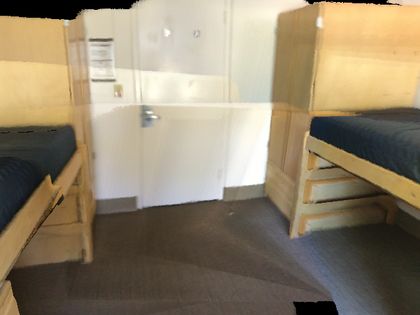
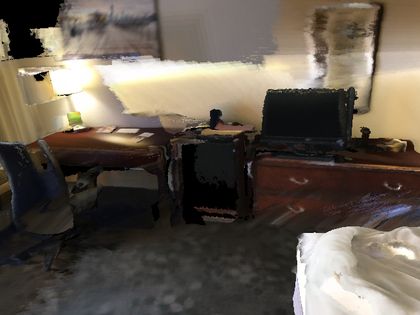
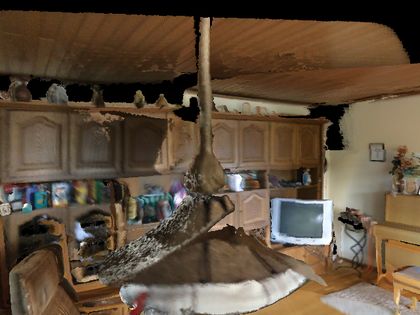
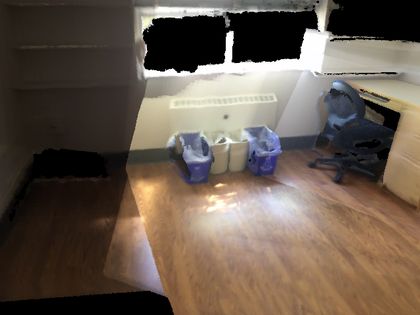
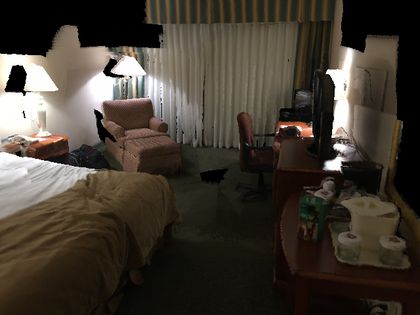
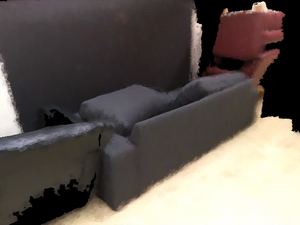
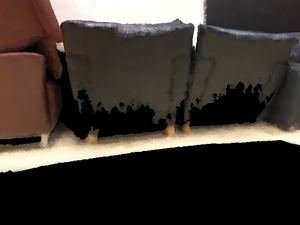
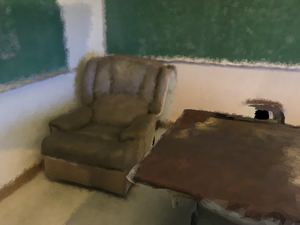
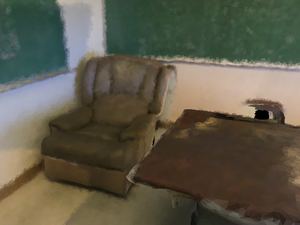
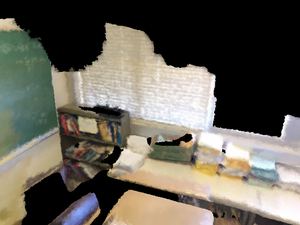
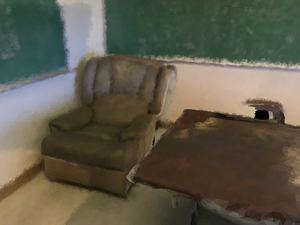
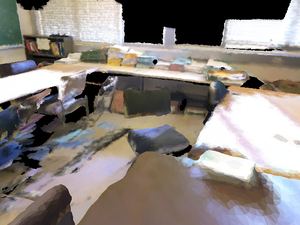
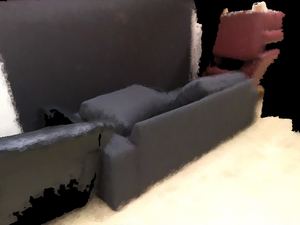
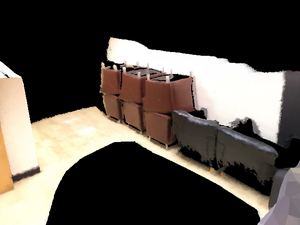
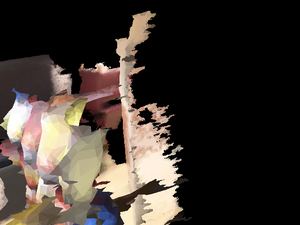
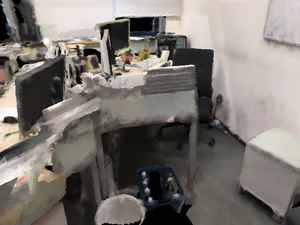
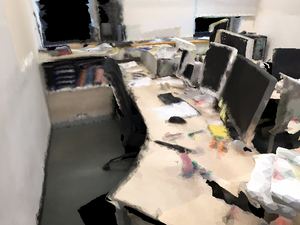
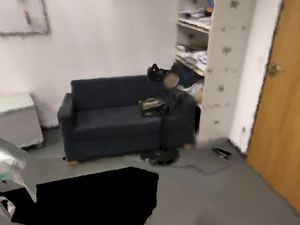
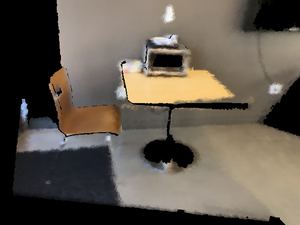
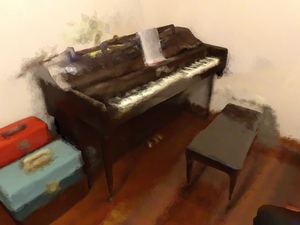
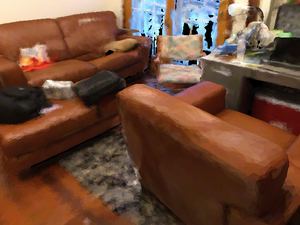
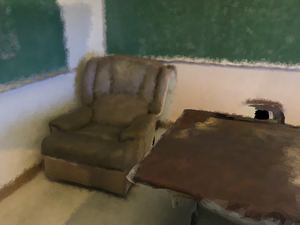
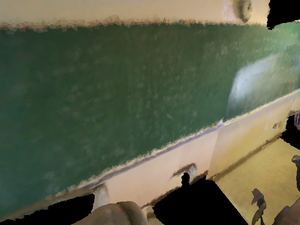
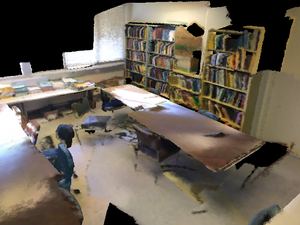
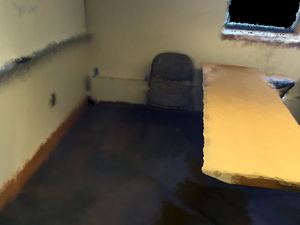
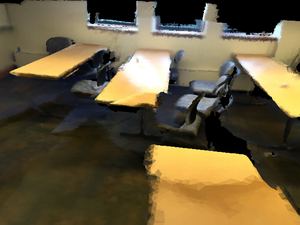
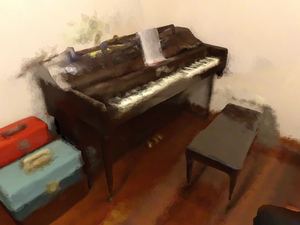
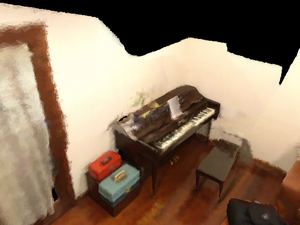
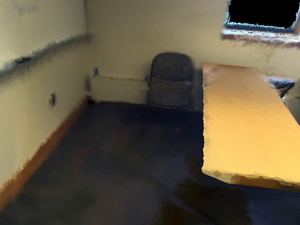
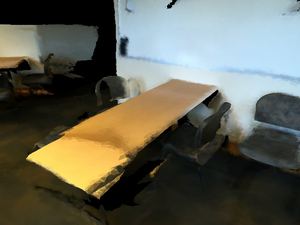
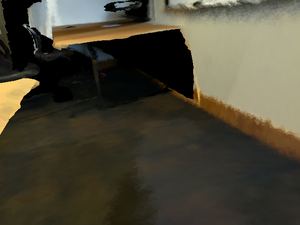
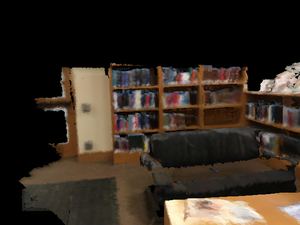
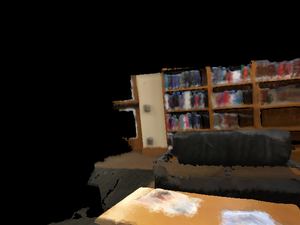
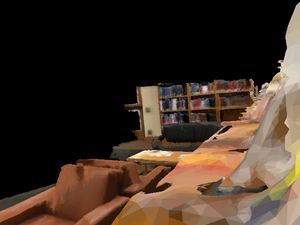
Project overview (68 s). Every indoor frame shown is a real rendered view the
policy asked for during evaluation.
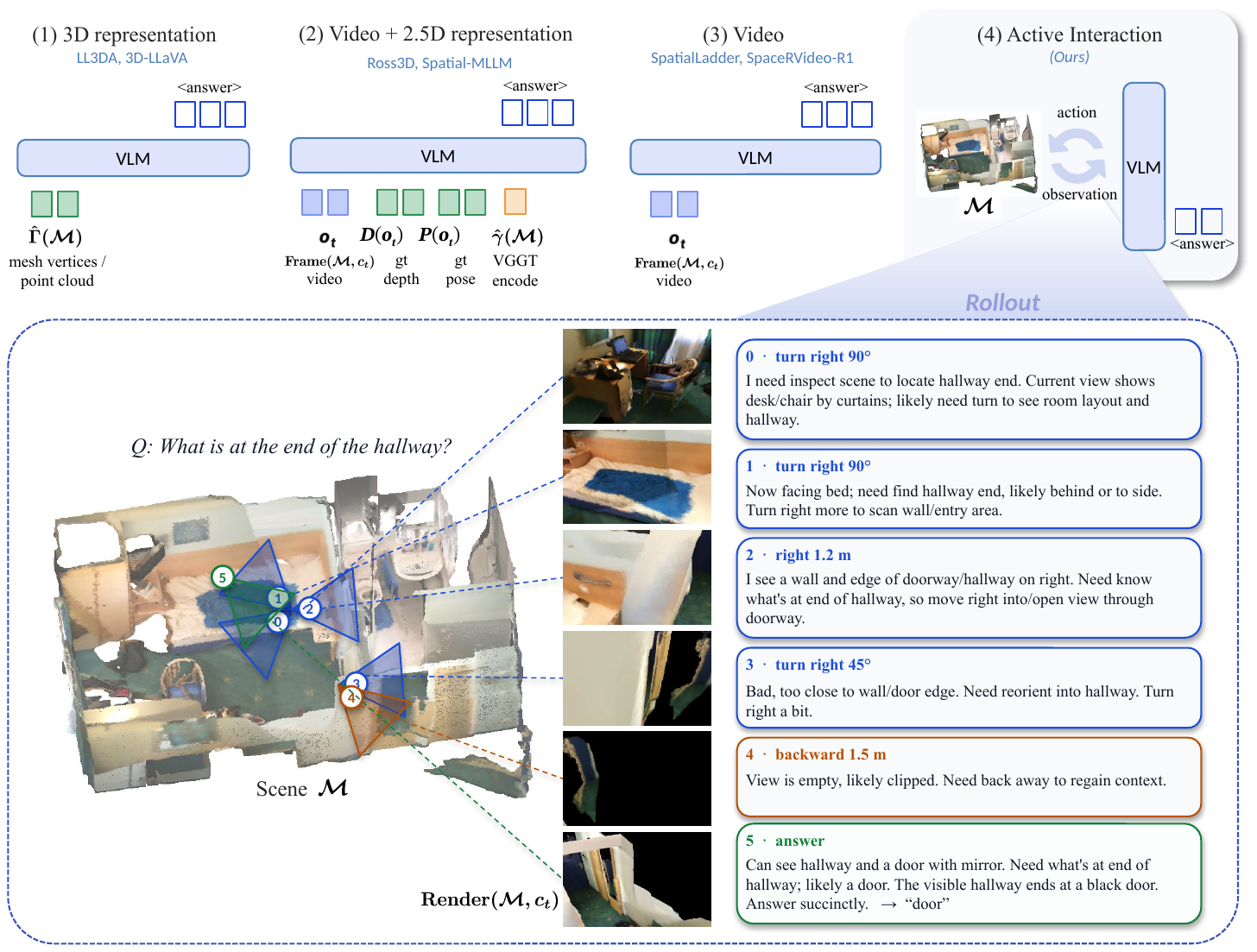
Prior 3D vision–language models study spatial reasoning under observations specified a priori — complete RGB-D scans, multi-view images, videos, or explicit 3D representations such as point clouds and meshes — treating the acquisition of task-relevant evidence as a prerequisite rather than part of reasoning itself. Act3D is handed one image. The 3D scene stays outside the model, as an environment it can act in — move left, turn right, step forward — with each action returning a newly rendered egocentric view. Reasoning and evidence acquisition happen in the same rollout, and nothing in training tells the model which viewpoint was the right one to visit.
Act3D. Starting from a single rendered view and a question, the policy alternates reasoning, a camera action, and a new observation, committing to an answer only once it has the evidence.
Abstract
We study how vision-language models (VLMs) can learn to think and actively explore in 3D space. Instead of providing multi-view images, videos, or 3D representations to the model, we preserve the native visual encoding of VLMs — a single image, one at a time, just like humans — and treat the 3D representation only as an environment with which the model can interact through actions (e.g., move left) and observations (rendered images).
Each rollout begins from an initial first-person view and a visual question. The model can then iteratively reason, navigate, and reorient its viewpoint before committing to a final answer. Following an initial trajectory-supervised finetuning, we apply reinforcement learning (RL) with rewards driven primarily by final-answer correctness. Crucially, RL provides no direct supervision over which viewpoints the model should visit or which exploration actions it should take. Instead, the model must learn an effective exploration policy solely from the extent to which its interactions improve performance.
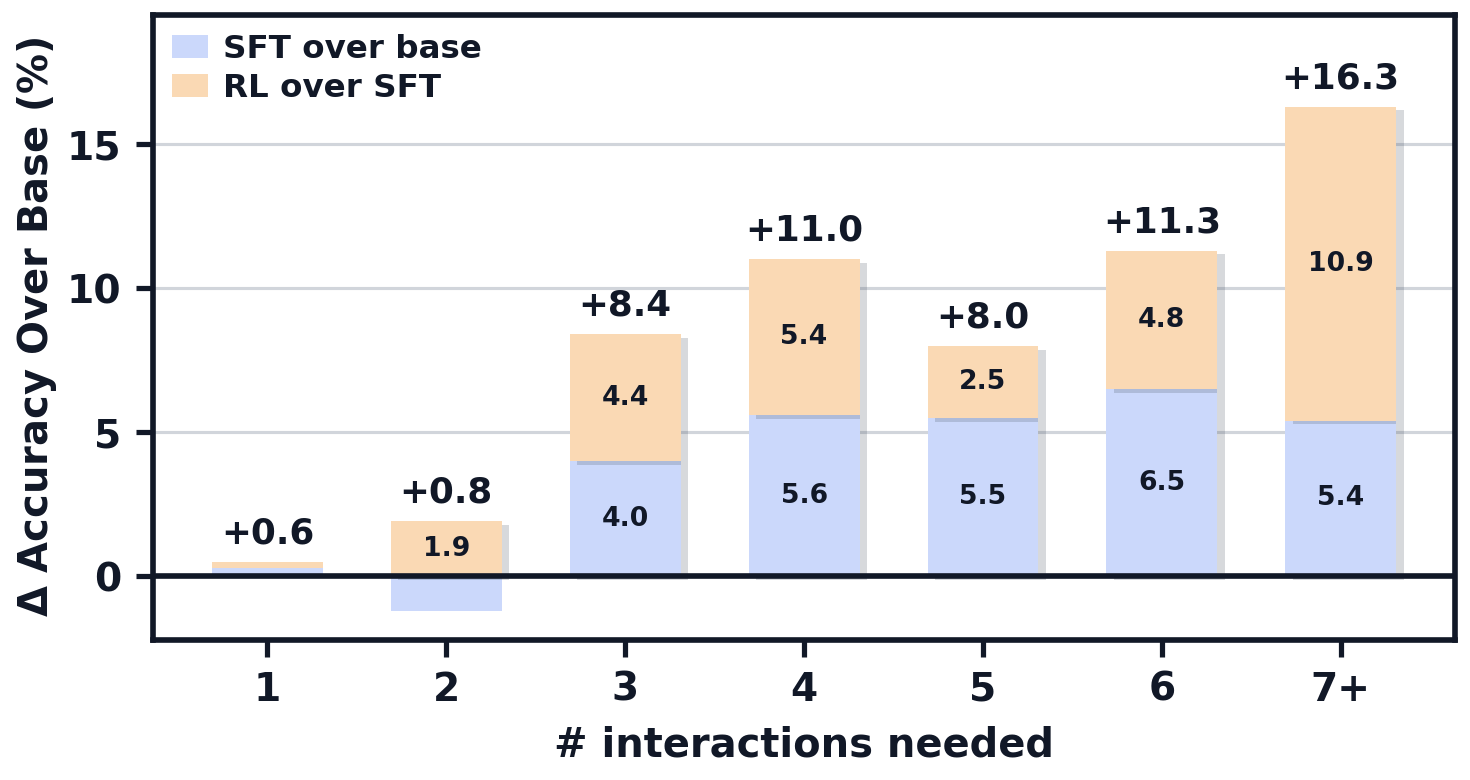
Across six 3D benchmarks, Act3D achieves an average accuracy of 53.2%, improving its base Qwen model by 22.0% and surpassing proprietary Gemini 3.6 Flash. Act3D also outperforms existing open-source 3D methods while using 50–70% fewer input frames, and generalizes to unseen domains with an average improvement of 5.9% over its supervised initialization. Further analysis reveals adaptive, question-conditioned exploration: gains over the base model increase from 0.6% on questions answerable from the initial view to 16.3% on those requiring extensive exploration. Act3D searches for occluded targets, avoids unnecessary exploration, and acquires complementary viewpoints for spatial comparisons. These findings demonstrate that outcome-based RL enables VLMs not only to reason over visual evidence, but also to learn when and how to acquire it.
Method
We formalize 3D reasoning as a POMDP. A task instance \((\mathcal{M}, q, y^\star)\) pairs a reconstructed scene \(\mathcal{M}\), a question \(q\), and an answer. The scene is hidden: the policy sees only the rendered egocentric view \(o_t = \mathrm{Render}(\mathcal{M}, c_t)\) at its current camera pose \(c_t\), and changes what it can see by acting.
Six translations (forward/backward, left/right, up/down) and four rotations, each with an integer step multiplier — 80 navigation actions, plus a terminal answer action. Relative, camera-centric moves rather than absolute poses in a frame the policy never observes.
Training has two stages. Trajectory-supervised initialization establishes the reason–act–observe protocol from 5,712 curated demonstrations; we emphasize that these provide policy initialization, not canonical exploration targets. Outcome-driven RL then optimizes the full interactive policy with GRPO, against a reward that depends only on how the episode ends — the full breakdown sits with the data it scores.
What the policy learns
1 · Interaction grows on its own
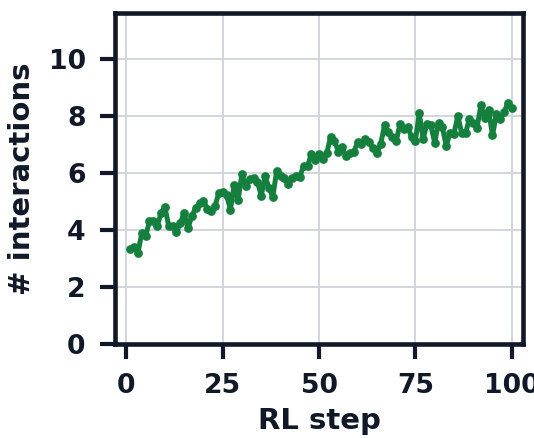
Nothing prescribes an exploration budget. Over mixed-data RL the average number of interactions per episode increases from approximately 3.3 to 8.3 while accuracy rises, indicating that RL progressively encourages more extensive interaction with the environment.
2 · Supervision buys stability, not capability
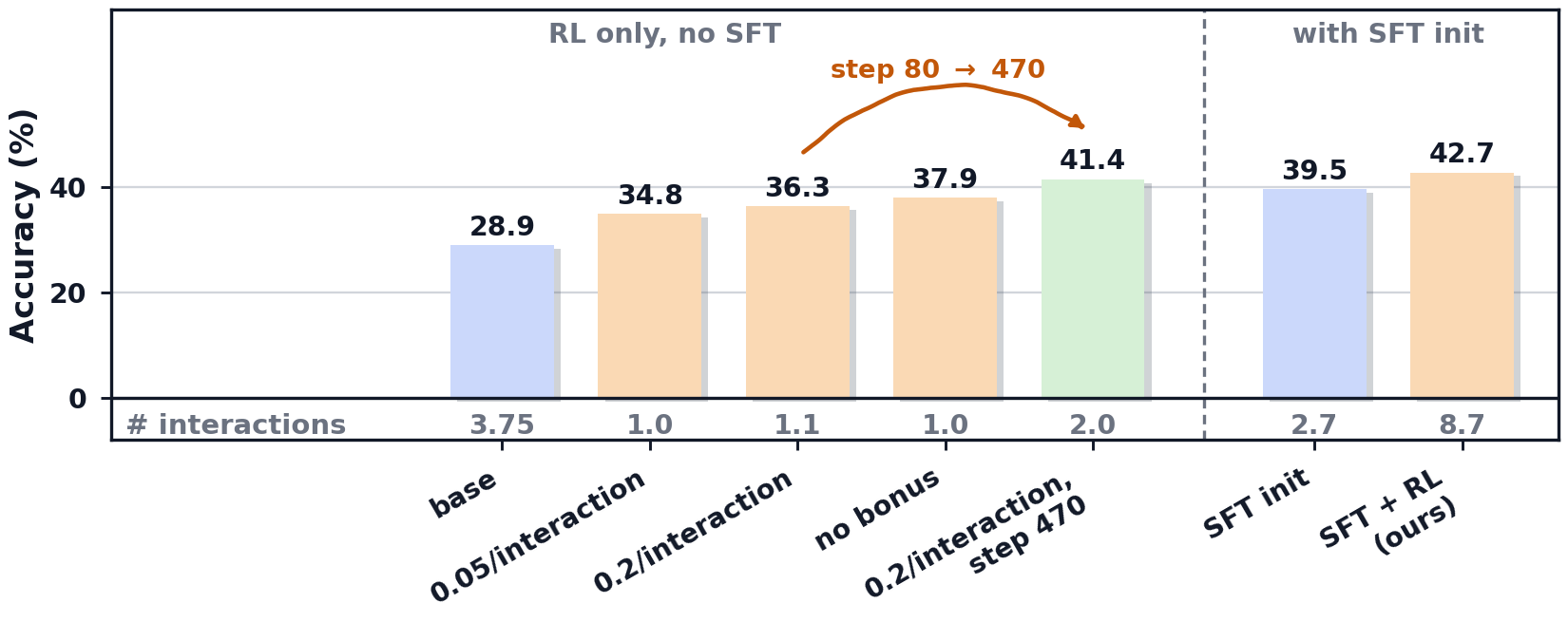
Without SFT, direct RL improves ScanQA accuracy from 28.9% to 34.8–37.9% after 80 steps, but performs only about one interaction per episode; extending training to 470 steps reaches 41.4% with 2.0 interactions. From an SFT initialization the same optimizer goes 39.5% → 42.7% with interactions rising 2.7 → 8.7. Supervised initialization facilitates adaptation to the interactive setting rather than being strictly necessary.
3 · Pose fidelity beats image fidelity
Retrieved real images can deviate substantially from the requested pose, introducing inconsistencies between executed actions and subsequent observations. Under matched training, rendering outperforms nearest-view retrieval across all 13 evaluation checkpoints, achieving 10.6% higher accuracy on average.
Training data
Two corpora, built for different jobs. Trajectory supervision needs a
few thousand complete reason–act–observe episodes; RL needs only a question, an answer, and a valid
starting viewpoint, so it can draw on an order of magnitude more. Every question type below survives the same test:
it must still be well posed when the model starts from one view and has to go and find the rest.
Trajectory supervision. 20,603 rendered observations over 830 scenes.
ScanQA3,00052.5%
MP3D2,00035.0%
ESI71212.5%
Reinforcement learning. 2,382 scenes; no demonstration needed, only a verifiable answer.
ScanQA25,56349.6%
MP3D9,85519.1%
Curated ScanNet8,59116.7%
Curated ARKit7,53414.6%
What the supervised episodes are made of
We use GPT-5.4 to generate reason–act–observe trajectories in
the same environment the policy acts in. We discard invalid starting views and retain trajectories with correct
answers, valid interactions, well-formed reasoning and responses, and sufficient visible scene geometry; MP3D
examples must also observe the evidence the question requires. After answer canonicalization the corpus contains
5,712 trajectories, 20,603 rendered observations and 830 scenes.
ScanQA
what2,118
other403
how271
where208
MP3D
inter-object space1,057
inter-object attribute700
single-object243
ESI
perceptual grounding314
spatial relations129
cognitive mapping96
metric comparison91
specular reflection48
enumerative perception34
Curated questions for RL, and why these types
RL requires only a question–answer pair and a valid initial
viewpoint, allowing substantially broader training data than trajectory supervision: 51,543 questions from ScanQA,
MP3D, and generated QA over ScanNet and ARKitScenes. Those generated QA begin as 53,104 candidates, of which 16,125
survive two filters. A heuristic pass drops anything a single view already answers, anything with degenerate ground
truth, and anything phrased as ego-relative left/right — ill-defined once the camera is free to move. An LLM
audit then rejects questions whose answer leaks in the prompt, questions too vague to have one answer, and questions
whose ground truth is wrong.
“Is there a sink in the room?”existence · 20,275 generated · answer: no
“Which is there more of, pillows or televisions?”comparison · 12,302 generated · answer: pillow
“Which is closer to the window, the books or the cabinet?”nearest · 6,386 generated · answer: books
“How many desks are in the room?”count · 5,419 generated · answer: 2
“What color is the desk?”colour · 4,553 generated · answer: black
“Which is taller, the sofa or the window?”vertical · 3,717 generated · answer: sofa
“Which is the largest object in the room, the bed or the dresser?”size · 291 generated · answer: bed
“What is on the desk?”on-top · 161 generated · answer: lamp
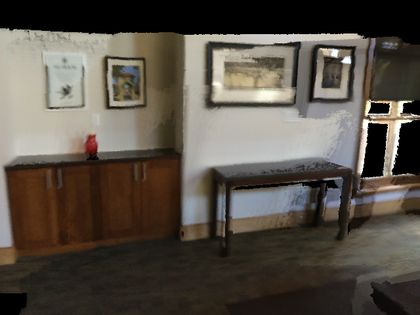
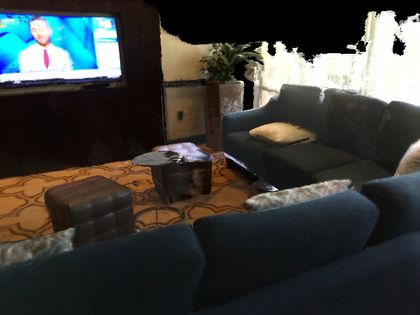
One kept question per type, each shown with the starting view its episode begins from —
rendered through the same tool the policy calls, so this is literally the image the model is handed before it moves.
The surviving types share a property that matters for active perception: the answer is a fact about the
scene, not about where the camera happens to be, so it stays well defined no matter which viewpoint the
policy chooses — while still, as these views show, rarely settled from the initial view alone.
What these questions are rewarded for
The curated questions are usable for RL because they can be scored
without a demonstration. GRPO optimizes the whole episode against the end of it alone:
Answer correctness, an interaction term gated on being correct and saturating at \(N_{\max}=12\), and a format penalty. No term references a target viewpoint, action, or trajectory — exploration is credited only through its effect on the final answer.
Real episodes from these corpora
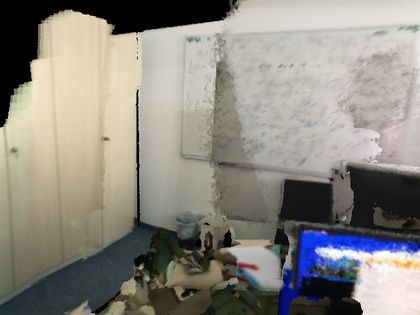
Each card is one ScanQA evaluation episode: the first view the
policy was given, a view it chose part-way through, and the view it answered from, with the number of interactions
it took. The tag under each answer names what the question asks for; none of these episodes could be
settled from the starting view alone.
How many black chairs are next to the chairs?answer: 2count · 7 interactions
How many chalk boards are there?answer: 2count · 8 interactions
What color is the table against blackboard?answer: browncolour · 3 interactions
What's the color of the chair stacked in a row?answer: browncolour · 7 interactions
What objects are closest to windowsill on shorter desk?answer: monitornearest · 7 interactions
What color is the cabinet next to the fridge?answer: browncolour · 8 interactions
Where is the laptop located?answer: on deskplacement · 7 interactions
Where are the two different size tables located in room?answer: in center of roomplacement · 7 interactions
What color is the wooden desk on the first row of the classroom?answer: browncolour · 7 interactions
What is on the ottoman?answer: backpackon top · 7 interactions
What is placed in front of a desk?answer: chairobject · 6 interactions
What type of loveseat is in a library?answer: black leather loveseatobject · 6 interactions
Results
Six 3D benchmarks, one interaction protocol
Every active model receives the same single 640×480 initial render and the same twelve-interaction budget; passive methods keep their own input protocols. Green marks a benchmark whose domain appears in that model's training data. Act3D trained on mixed data achieves the highest average accuracy of 53.2%, surpassing the Qwen3.5-9B base model by 22.0% and Gemini 3.6 Flash by 1.0% under the same interaction protocol, as well as all evaluated open-source 3D reasoning methods. Against its own SFT initialization, RL improves the average from 48.6% to 53.2% (+4.6%), with the largest gains on ARKit (+14.1%) and SPBench-MV (+8.1%).
Model
ScanQA
SQA3D
SPB MV
SPB SI
MP3D
ARKit
Avg
Passive perception
Video-R1-7B
30.8
41.1
42.0
39.6
42.6
63.4
43.2
ViLaSR-7B
33.3
47.6
52.6
43.4
34.6
66.0
46.2
SpatialLadder-3B
29.3
40.4
61.2
45.2
45.2
58.7
46.7
InternVL3.5-38B
36.2
47.0
36.9
38.7
51.1
75.4
47.6
SpaceR-7B
31.6
44.7
52.6
41.0
52.0
70.1
48.7
Ross3D
50.7
62.6
32.0
31.9
55.2
71.5
50.7
Active interaction
Qwen2.5-VL-72B
16.8
26.8
20.8
19.1
26.7
46.8
26.2
Qwen3.5-9B (our base)
36.7
33.5
21.3
24.7
30.9
40.1
31.2
Qwen3.5-27B
27.5
40.2
33.2
31.4
33.8
33.8
33.3
InternVL3.5-38B
30.9
41.5
43.2
41.6
50.1
55.8
43.9
Gemini 3.6 Flash
43.3
53.8
45.5
44.4
53.4
73.0
52.2
Ours — trained on ScanQA only
SFT init
39.4
46.0
47.3
41.2
44.7
68.3
47.8
Act3D
45.5
49.8
47.6
42.3
50.7
67.6
50.6
Ours — trained on mixed data
SFT init
39.3
47.4
39.2
37.7
61.8
65.9
48.6
Act3D
42.1
49.0
47.3
37.4
63.3
80.0
53.2
Accuracy rises; so does interaction
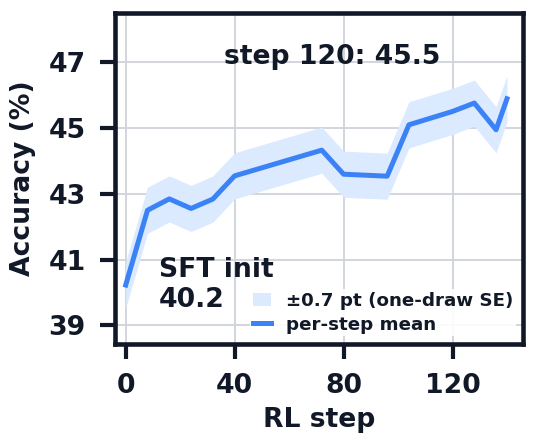
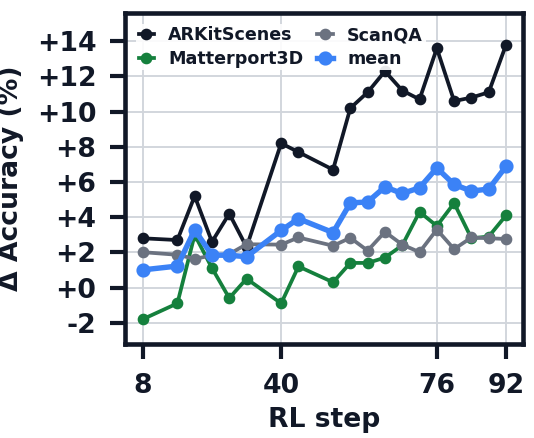
(a) ScanQA-only run: validation accuracy improves from 40.2% to 45.5%.(b) Mixed data: improvements across all three validation benchmarks, largest on ARKitScenes.(c) Mean interactions per episode increase from approximately 3.3 to 8.3.
Panel (c) is in-training rollout statistics; (a) and (b) are offline validation accuracies, and no value should be read across the two.
The gain is largest exactly where exploration is needed
ScanQA validation questions stratified by estimated exploration demand — the number of actions needed to approach the annotated answer object, estimated from its bearing and distance from the initial viewpoint, independently of the model's actual behaviour. The combined SFT and RL improvement rises from 0.6% in the lowest-demand group to 16.3% in the highest; RL contributes an additional 10.9% over SFT in the most demanding group.ScanQA accuracy against mean interactions per episode, with and without supervised initialization. Without SFT the policy performs about one interaction per episode after 80 RL steps and 2.0 after 470; from an SFT initialization interactions rise from 2.7 to 8.7. The two settings differ in backbone and training budget, so only the direction of change within each is comparable.
What the design choices are worth
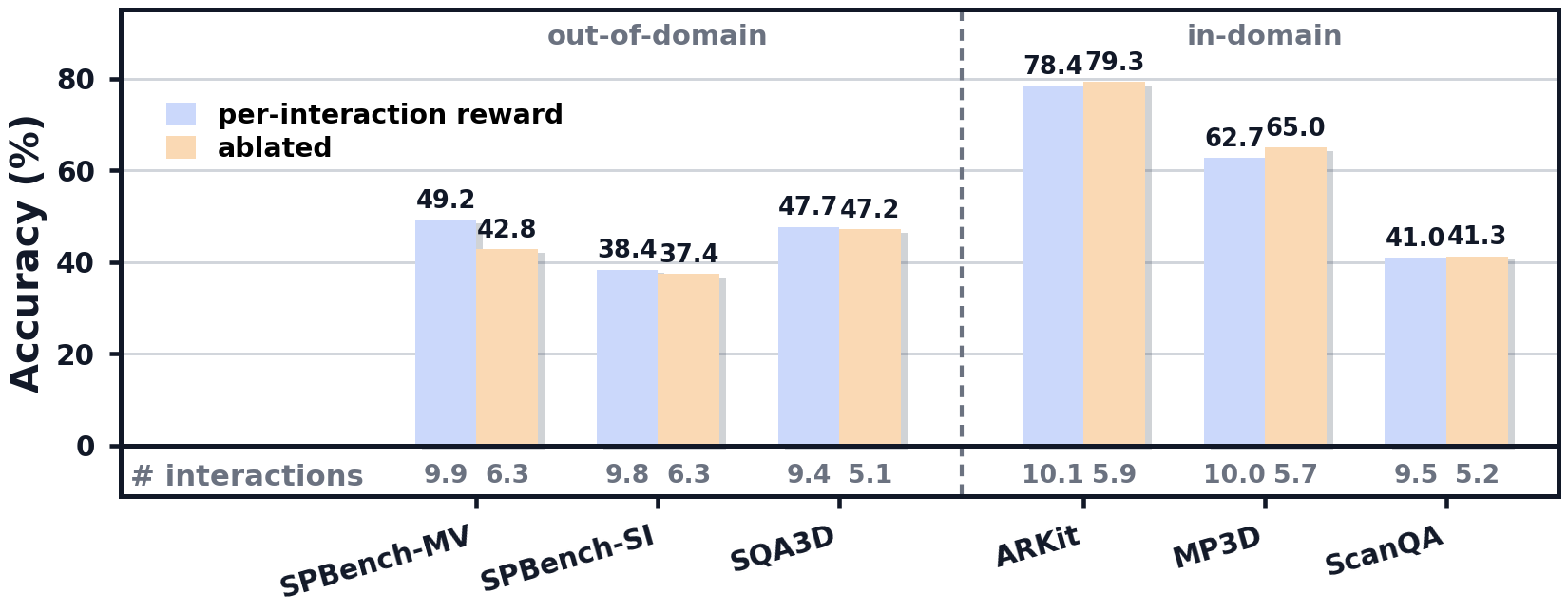
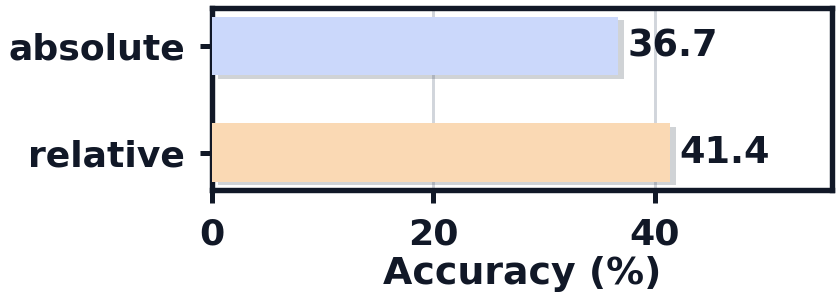
Interaction reward. A reward of 0.05 per interaction raises the average from 5.1–6.3 to 9.4–10.1 interactions per episode across six benchmarks, improving all three held-out benchmarks (SPBench-MV +6.4%) while slightly reducing the training domains (0.3–2.3%).Action space. Relative camera movements reach 41.4% on ScanQA against 36.7% for absolute pose prediction: relative actions operate in the camera's local frame, rather than a scene-dependent global one the policy never observes.Renders vs. real photos. Retrieved images can deviate substantially from the requested camera pose; rendering outperforms nearest-view retrieval across all 13 checkpoints, by 10.6% on average.
Exploration that fits the question
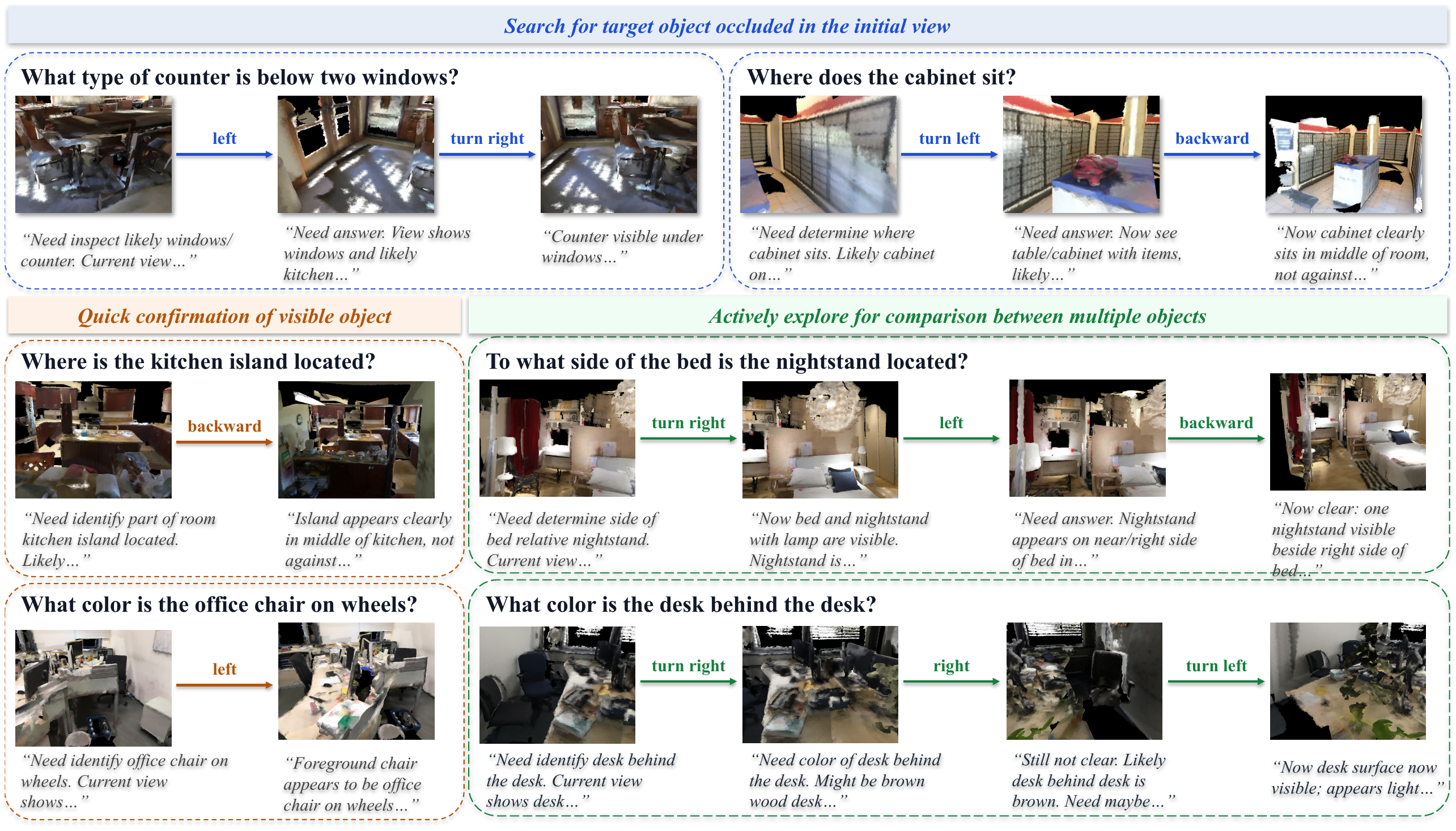
The policy searches when the target is occluded, makes a short confirmation when it is already visible, and gathers several viewpoints when the question compares objects. The reasoning trace updates with each returned observation and stops once the evidence is sufficient.
Conclusion
We present Act3D, a framework for learning to think and explore in the 3D world by treating 3D
representations as interactive environments rather than assumed-complete inputs. Starting from a single
observation, Act3D iteratively reasons, acts, and acquires visual evidence through interaction with the
environment. Building on supervised trajectory initialization, verifiable RL further optimizes the policy
without explicit supervision of exploration actions or viewpoints.
Across six 3D benchmarks, Act3D achieves the highest average accuracy of 53.2%, improving upon its
SFT initialization by 4.6% and outperforming existing active and passive 3D reasoning methods. Further
analyses show that these gains extend beyond the training benchmark and are particularly pronounced on
questions requiring more extensive exploration. Qualitative results also reveal question-conditioned
exploration strategies that adapt to newly acquired observations. Together, these findings demonstrate the
potential of outcome-based RL to learn not only how to reason over visual evidence, but also how to actively
acquire the evidence needed for 3D reasoning.
BibTeX
@misc{li2026act3d,
      title={Learning to Think and Explore in 3D World},
      author={Yijiang Li and Bingyang Wang and Nuno Vasconcelos},
      year={2026},
      eprint={2610.21783},
      archivePrefix={arXiv},
      primaryClass={cs.CV},
      url={https://arxiv.org/abs/2610.21783},
}